Enhancing Digital Capabilities
Challenge
As the world's largest events ecosystem, how can the Edinburgh Festivals improve their operation to ensure they take advantage of the digital revolution affecting all aspects of festival life?
Action
We created a new programme - Enhancing Digital Capabilities [EDC] - which was successfully pitched to the UK Government Department for Digital, Culture, Media and Sport (DCMS) who provided £1m of funding support to enable our Festivals to invest in various projects aimed at:
- enhancing their digital capabilities and strengthening their digital position, while helping the development of collaborative digital commissioning, production, distribution or promotional partnerships;
- increasing exposure of British cultural output to international markets to facilitate trade and boost UK exports;
- helping to leverage digital platforms and technology, which will help to reach new audiences, improve productivity and skills by increasing knowledge and utilisation of digital commissioning, production, distribution or promotional models and innovations; and
- building on the world-class curatorial and convening power of the Festivals through digital activity that will aid the presentation of work to audiences in the UK and across the globe.
Two major programes were developed - the Digital Marketplace expanded the role of the Edinburgh Festival Fringe as a showcase and international market for cultural product in a new online environment; and the Digital Expo Accelerator fund supported a broad and varied range of activities across the Festivals which allowed each to explore:
- commissioning and presenting new artistic work in digital forms;
- digital production techniques to shift aspects of the live festivals to digital formats, including both digital only and hybrid events;
- operational improvements and enhancements to digital systems (e.g. e-ticketing)
- audience engagement via digital platforms and channels;
- promotion and audience development using digital channels; and
- new digital methods for education and outreach work.
Results/Outcomes
The evaluation found evidence of positive outcomes across a range of areas:
- Digital Skills: all of the Festivals reported very substantial gains in their knowledge and skills relating to digital, even those already involved in digital working. There was also evidence of shifts towards a more strategic approach to digital working within the Festival organisations.
- Digital capability: the funding helped to develop digital infrastructure within the Festivals, including platforms, system improvements and infrastructure. New equipment and a range of digital work/ content/ assets were also important legacies that will support future plans, leaving the Festivals in a far stronger position regarding digital work.
- Audiences: the digital activities enabled all of the festivals to attract new audiences, and audiences that would otherwise not have been able to experience the festivals due either to geography or other barriers. This included strong international audiences and new bookers, and the Digital Marketplace achieved strong industry engagement.
- Economic Benefits: programme leverage was strong, with income generation in areas such as ticket sales for digital events. There was evidence that the Digital Marketplace is starting to facilitate industry bookings even if it is too early to quantify these. The new digital assets and infrastructure were also seen to deliver efficiencies for many of the Festivals.
- Reputation: the funding enabled the Festivals to produce high quality digital content and engage new and international audiences, enhancing further their reputation as world leaders in the event production field.
Lessons/Shared Learnings
The EDC Programme enabled Edinburgh’s Festivals to experiment with digital working in ways that would not otherwise have been possible. In so doing, their experiences highlight a number of learnings with wider applicability across the cultural and events sectors.
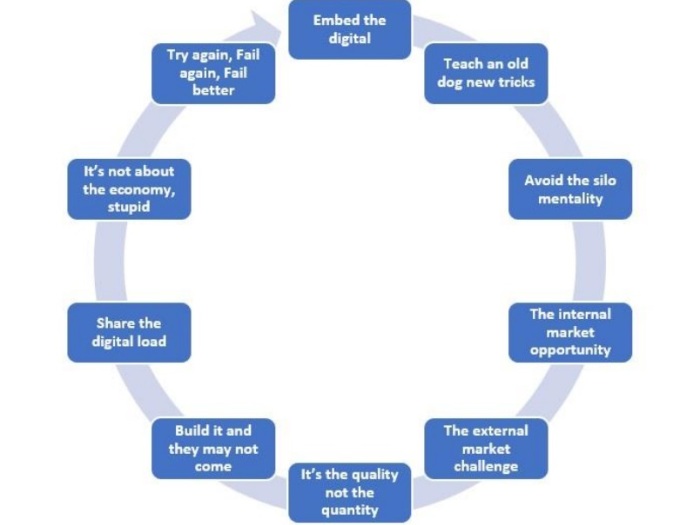
Embed the Digital
If digital thinking and practice is to become truly valuable in shaping the future of an organisation, it has to move from the periphery to the centre of organisational strategy. One of the most significant shifts across the Edinburgh Festivals landscape was that digital working changed from being an activity at the margins, mainly for promotional purposes, to something more embedded at a strategic level within the organisations. This came about through greater understanding and experience of how digital working can deliver across a host of core corporate objectives related to creation, production, distribution, and promotion. Embedding digital does not of course mean embracing a ‘fully’ digital future. The nature and extent of digital working will be a strategic choice for each organisation, and it should be one that is considered as a core part of organisational strategy and not as an afterthought.
Teach an old dog new tricks
Too often digital is seen as the remit of the marketing team, and often junior members of that team, rather than senior management. This limits the potential impacts and benefits of digital working and mitigates against the more strategic approach outlined above. Gaps in senior management digital skills and knowledge can make decision-making more difficult, preventing organisations from innovating and delivering value in creative, operational, audience and marketing terms. The commitment to digital working by senior leaders across the Edinburgh Festivals was crucial to the success of this programme of work, with many remarking on the need to acknowledge their skills weaknesses as a crucial element in not only the development of the organisation but also to rethinking their own personal development plans. One manager even remarked that the programme had crucially given the lie to the old adage that you can’t teach an old dog new tricks.
Avoid the silo mentality
In business, organisational silos refer to the situation that occurs when team members from different departments do not share important information or processes with other members because they are that isolated, exclusive, or remote. This lack of knowledge sharing can impact workplace productivity and result in collaboration failures. A business structure like this leads to a silo mentality. Each of the Edinburgh Festivals sought to maximise the opportunity of this programme by involving different members of staff from across different departments in the process rather than relying on one person alone (as can often be the case with digital projects). In various cases, a full team was developed, involving both internal staff and external partners, to support the delivery of digital programmes. This not only allowed multiple perspectives to be brought to the work, but also embedded the learning more widely within the organisation
The internal market opportunity
Too often when organisations refer to digital strategy it is shorthand for audience-focussed online activities, a tendency which was exacerbated during the pandemic when most organisations moved in to live streaming. However, a true digital strategy will reach across an entire organisation, identifying challenges which can be addressed through digital developments. Such developments often bring with them an internal market opportunity in that they provide moments to create efficiencies in operational practices through digital interventions. During this programme the Edinburgh Festivals identified relevant opportunities for such efficiency savings, with the development of integrated e-ticketing, booking systems and CRM (i.e. Customer Relationship Management) programmes being obvious examples where the use or improvement of digital systems delivered real value both to the organisation through saving costs and enhancing customer data and the audience through improved communication and booking experience.
The external market challenge
During the pandemic, there was an immediate shift to producing and distributing work online, with many organisations expecting a lucrative new income stream to result. However, one of the first issues that became clear to such organisations was that, without realising it, they had just entered a very crowded competitive marketplace where their offer would have to fight for audiences and revenue alongside major players with much larger resources - and that this would happen in a market where the normal geographic restrictions on audiences seeing an event had been removed. Thus the need to identify the unique selling proposition [USP] became even greater in this brave new digital world. For the Edinburgh Festivals this realisation brought a lot of soul searching and a degree of clarity about what is their fundamental USP: the delivery of extraordinary in-person communal experiences. As such, the festivals felt that they should not try to replicate everything in digital form but rather be very clear about those areas where digital developments could enhance their offer rather than diminish it.
It’s the quality not the quantity
The common perception is that digital is cheaper and that content can, and should, be created and distributed regularly. During the pandemic period all organisations pivoted swiftly to such a digital distribution model, seeing that as the only way in which they could provide work for artists and shows for audiences. However, as we emerged from that period it was clear that audience behaviour was changing and that they were no longer satisfied to watch content of an inferior quality. This change was already evident even during the pandemic, where the initial bubble of online quizzes and fitness classes quickly burst, and the quality threshold for long-form content has now firmly asserted itself. The reputation of Edinburgh’s Festivals is rightly dependent on the quality of the work, and this was purposely maintained through this programme. Filming and camera techniques, editing and treatment of sound, as well as issues like live captioning all needed to be considered in light of the work being presented, and learning curves in this respect were steep. But quality matters and quality costs.
Build it and they may not come
Improving and extending the experience - through behind the scenes content, online platforms, learning, engagement and interactivity through social channels – is seen as a natural progression for cultural organisations. However, when it comes to the digital distribution of such experiences and content there is a choice. Organisations can build their own bespoke platform, which will offer greater control but require upfront investment and a lot of hard effort to generate an audience. Alternatively, an organisation can work with existing channels (eg YouTube, Vimeo etc) which has the benefit of an existing and interested audience, sometimes in large numbers, even if some of the terms and conditions may require organisational compromise. During this programme the Edinburgh Festivals experimented with both modes of operation and on balance the experience is that the latter is more practical, given the questionable assumption that people will come to bespoke platforms and the problem of securing long-term sustained investment.
Share the digital load
There is no doubt that adopting digital working is challenging and learning curves are steep. Finding the right partners is therefore essential, whether that is creative or technical and it is important to approach the challenge with a partnership mentality from the outset. Every cultural organisation has its own programming perspective and will respond to opportunities or challenges in its own way relating to its business operation, but it is important to be open to looking beyond their sector for digital expertise while also seeking partnership with peers that may be further down the digital road. Such partnerships de-risk innovative digital operations, which can be problematic in their initial stages, allowing organisations to ‘hedge’ their bets and share the digital load. What was of particular interest to the Edinburgh Festivals during this programme was the opportunity to open dialogue with others, particularly the business, academic and developer sectors in the city, and the fact that some of these led to practical programmes of new operation - and the evolution of what is hoped will be long-term relationships.
It’s not about the economy, stupid
A lot has been written about the potential income streams which cultural organisations could secure from developing more effective online activities, with most of it focusing primarily on the transactional nature of event attendance. However, this appears to value arts and culture primarily for the economic contribution rather than the wider contribution to ideas or society – and it fails to address one of the fundamental points of difference in how cultural organisations, as opposed to creative industries, approach the digital question. Cultural organisations are not driven by the profit motive and as such are reluctant to adopt practices that might exclude audiences on the basis of income and thus damage long developed inclusivity agendas. During this programme the Edinburgh Festivals experimented with different purchase models, including ‘pay what you can’, and came to clearly understand that digital should not be seen as a solution to difficult trading conditions, but more as a means of enhancing, extending and improving cultural work and its presentation.
Try again, fail again, fail better
Digital development in the cultural sector is still evolving. What works for one type of organisation will turn another off and for every success there will be failures. However, experimentation and a willingness to take risks are essential ingredients for innovation. As noted previously, partnerships can be a crucial element in de-risking innovations and thus creating a suitable environment for experimentation. But the corporate ethos needs to be ready to embrace risk in and of itself, and see it as a fundamental value of any evolving cultural organisation. This is a difficult position to take, especially at moments when there is an existential threat to organisational survival as was seen during the pandemic and currently during the cost-of-living crisis. What this programme allowed the Edinburgh Festivals to do was take further risks and enhance their long-term brand positioning as ‘laboratories’ of new thinking and new practice - and create a secure test bed for new projects which could succeed or fail on their own merits, without affecting the integrity of the entire festival business operation. The concept of risk and experimentation is crucial to the festivals, as is the knowledge that experiments by their very nature can fail. In reflecting on their approach to digital, one festival cited the great Irish dramatist Samuel Beckett: ‘Try again. Fail again. Fail better.’